There is no objective way to name the ugliest car ever, but the original Fiat Multipla has one of the strongest claims. In a 2024 CarThrottle poll involving 3,303 votes, the Multipla finished first with 33%, ahead of the Pontiac Aztek at 25%. The Prius placed third and the SsangYong Rodius fourth.
That poll is not a scientific verdict on automotive beauty, but the result matches a wider pattern: the Multipla and Aztek have spent years appearing in discussions of controversial car design. CarThrottle’s ugliest-car poll
What Is the Ugliest Car Ever?
If one model has to be named, the original pre-facelift Fiat Multipla is probably the strongest candidate based on repeated automotive-media appearances and public polling.
MotorTrend includes the first-generation Multipla in its all-time ugly-car selection and focuses on the same features that made the car so divisive: the unusual hood, enormous glass area and the visual split between the lower body and upper cabin.
The Pontiac Aztek is its closest American rival. Its production design combined a tall, narrow body with small-looking wheels, stacked details and extensive plastic cladding, creating a much busier shape than the concept that preceded it.
The top 10 below is therefore not presented as an objective design ranking. It focuses on cars that repeatedly became targets of criticism because their proportions, lighting, surfaces or styling concepts departed sharply from what buyers expected.
10 Ugliest Cars Ever Made
1. Fiat Multipla
The first Multipla is the obvious place to start.
Its front end appeared to have two separate levels. Conventional headlights sat low in the nose, while another pair of lights was positioned near the base of the windshield. A wide band beneath the glass made the whole upper section look almost like a second car placed on top of the first.
Add the unusually tall glasshouse and extremely wide proportions, and the result was difficult to confuse with anything else.
The Multipla’s problem was not that it lacked an idea; it was that too many visual ideas were stacked on top of one another.
Yet the shape served a purpose. Fiat managed to fit three seats across in both rows, giving six people space in a relatively short vehicle. Its strange appearance was closely connected with unusually clever packaging.
That contrast is part of why the Multipla remains so interesting: visually awkward outside, genuinely inventive inside. MotorTrend’s all-time ugly-cars feature
2. Pontiac Aztek
The Pontiac Aztek became shorthand for controversial American car design almost as soon as it appeared.
Its production version was taller and narrower than the original concept, while the wheels looked small against the heavy body. Thick plastic cladding covered much of the lower half, and the front and rear were divided into multiple horizontal layers.
The Aztek looked less like a single shape than a pile of competing surfaces, textures and proportions.
MotorTrend notes that the production model lost the wider stance of the concept and gained considerable plastic cladding. At the same time, it was surprisingly practical, with a roomy cabin, clever cargo features and even an optional camping setup.
In hindsight, that utility also makes the Aztek feel strangely modern: it anticipated the lifestyle-crossover idea years before the market became saturated with such vehicles.
3. SsangYong Rodius
The first-generation SsangYong Rodius is most difficult to process from the side and rear.
Its large MPV body rises high above the wheels, while the rear roof treatment appears to introduce a second visual direction that does not quite agree with the rest of the vehicle.
The Rodius looks most unsettled at the rear, where the roofline and heavy body mass seem to belong to different vehicles.
That shape was created around the practical demands of a large people carrier, but the resulting proportions regularly made the Rodius an easy target in lists of unconventional automotive design.
Unlike the Multipla, where much of the controversy sits at the front, the Rodius becomes stranger the farther back you look.
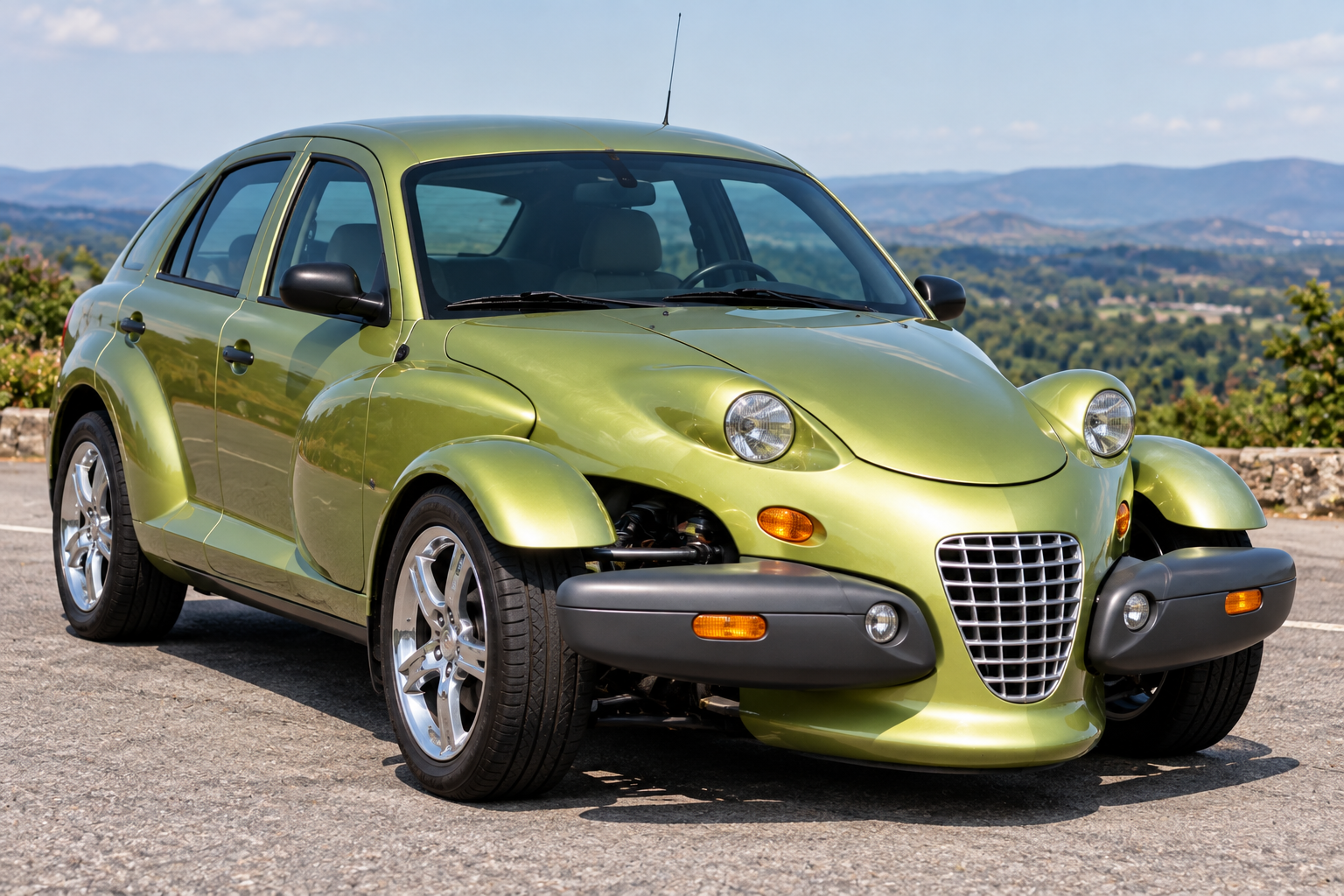
4. Chrysler PT Cruiser
The PT Cruiser is an important inclusion because its styling was deliberately retro.
Chrysler combined a tall hatchback body with visual references to prewar American cars and hot rods: separate-looking fenders, a prominent grille and a roofline intended to make a modern compact vehicle feel much older than it really was.
For some buyers, that personality was exactly the appeal. For others, the mixture aged quickly.
Retro styling can date quickly when the reference becomes more obvious than the underlying proportions.
It would also be inaccurate to claim that everyone hated the PT Cruiser. The car found plenty of buyers and developed a recognizable identity. It is on this list because few mainstream cars of its era produced such a sharp split between people who found the design charming and those who found it awkward.
5. Nissan Cube
The Nissan Cube did something most production cars actively avoid: it made asymmetry one of its defining styling features.
The squared body already gave it unusual proportions, but the rear made the Cube instantly recognizable. The side glass appeared to wrap around one rear corner while stopping differently on the opposite side, creating an intentionally unbalanced appearance.
The Cube turns asymmetry into a feature rather than trying to hide it.
The almost vertical sides and rounded rectangular details reinforced the sense that Nissan wanted the vehicle to look like a piece of modern product design rather than a conventional hatchback.
That is also why the Cube has aged differently from some cars on this list. Plenty of people now see it as quirky or clever rather than simply unattractive.
6. Nissan Juke
The first Nissan Juke became controversial largely because of its face.
Instead of one conventional pair of headlights, the front used several levels of lighting. Narrow lamps sat high on the fenders, large round main lights appeared much lower down, and additional elements occupied the bumper.
The Juke’s front end breaks the familiar idea that a car should have one obvious pair of eyes.
Its rear styling was much more coupe-like, while large wheel arches and a high body gave it unmistakable crossover proportions.
That unusual combination also worked commercially: the Juke became highly recognizable and helped establish the small crossover as a major market category. Polarizing design did not stop it from creating a strong identity.
7. AMC Gremlin
The AMC Gremlin is remembered for one particularly abrupt styling decision.
From the front through the doors, its proportions look relatively conventional for an American compact of the period. Then the body appears to stop.
The long hood and sharply cut-off rear created a profile unlike almost anything around it. The wheelbase and cabin proportions made the truncated rear look even more dramatic.
Its shape was partly a practical way to create a smaller car without developing an entirely new platform, but the visual result became the Gremlin’s defining feature.
Decades later, that same awkwardness has become part of its appeal.
8. AMC Pacer
If the Gremlin was defined by what was missing at the rear, the AMC Pacer was defined by glass.
Its rounded greenhouse was enormous, with deeply curved windows creating an almost panoramic cabin. The car was also unusually wide for its length, making the proportions feel even more exaggerated.
The Pacer looked futuristic when it arrived, but it was a very specific kind of 1970s futurism.
Today that makes it interesting rather than anonymous. Its shape immediately signals an era, and surviving examples have a character that conventional contemporary cars often lack.
It is a good example of how yesterday’s awkward design can become today’s quirky classic.
9. Ford Scorpio — Second Generation
Not every Ford Scorpio belongs on an ugly-car list. The controversial styling is associated primarily with the second-generation model introduced in the 1990s.
The most debated element was the front: large oval headlights and a rounded fascia gave the executive car a facial expression unlike the conservative sedans buyers in the segment were accustomed to.
The rear was similarly rounded and visually complex.
The problem was partly one of expectation. Experimental styling can feel very different on a small niche car than on a large executive model whose buyers expect visual restraint.
That mismatch helped make the later Scorpio far more memorable than Ford probably intended.
10. Toyota Prius — Fourth Generation
The Prius is a useful example because controversial styling did not stop the model from being successful.
The fourth generation leaned heavily into angular details. Its headlights stretched sharply into the body, while the rear used complicated vertical lighting and multiple intersecting surfaces.
The effect was intentionally futuristic but also unusually busy.
The Prius name finished third in CarThrottle’s 2024 poll, although criticism of Prius styling has varied significantly by generation.
That distinction matters. Calling every Prius ugly would ignore how much the design changed over the years. The fourth generation stands out because it pushed the model’s visual experimentation particularly far.
Why Do Some Cars Look “Ugly”?
There is no equation for unattractive car design, but certain patterns repeatedly create strong reactions.
Awkward Proportions
A tall body sitting on visually small wheels can make a vehicle appear unstable or under-wheeled. A very long hood, abrupt rear overhang or unusually narrow stance can produce the same effect.
The Aztek and Gremlin show this in completely different ways.
Too Many Competing Elements
Some cars attract criticism because no single feature dominates.
The Aztek combines cladding, stacked sections, multiple lines and contrasting surfaces. Instead of guiding the eye across one coherent shape, the details compete for attention.
Unusual Lighting
Headlights act almost like a car’s face.
The Multipla and Juke disrupted familiar expectations by putting lights in unusual positions or separating them across several levels.
Asymmetry
Most cars are highly symmetrical, particularly when viewed from the front or rear. The Nissan Cube deliberately breaks that rule, which is one reason its design is so memorable.
Retro Styling
Retro cars can look fresh when their historical references feel subtle. When the theme dominates the entire design, however, the result can become closely tied to one moment in fashion.
That helps explain why reactions to cars such as the PT Cruiser change over time.
Fiat Multipla vs. Pontiac Aztek: Which Is More Often Called the Ugliest?
The Fiat Multipla currently has the stronger case if the question is based on repeated lists and public polling.
In CarThrottle’s 2024 vote, the Multipla received 1,102 of 3,303 votes, or 33%, while the Aztek received 817 votes, or 25%.
The Multipla also appears in MotorTrend’s all-time ugly-car collection, while the Aztek has become one of the best-known American examples of a production design that was received much more harshly than its concept.
So if one car has to be named, the Multipla has a particularly strong claim. The Aztek remains its closest American counterpart, and arguably the more culturally famous of the two.
Do Ugly Cars Sometimes Become Cool?
Yes. Time can change the way an unusual design is perceived.
The Aztek is a clear example. MotorTrend notes that it developed a cult following despite the criticism that followed it from launch. Its practical features, early crossover concept and later pop-culture visibility helped people reconsider it.
The Cube and Pacer have gone through similar shifts. Once a strange design becomes rare enough, it can stop looking merely wrong and start looking distinctive.
Nostalgia matters. So does the fact that modern cars can become visually similar as manufacturers respond to the same aerodynamic, safety and market pressures.
A strange car can age into a design icon precisely because nobody mistakes it for anything else. Polarizing is not always the same as bad, and the cars people argue about longest are often the ones with the strongest visual identity.
The Fiat Multipla and Pontiac Aztek remain two of the strongest candidates whenever drivers and automotive publications debate the ugliest car ever. But their reputations also show why the argument never really ends: a shape that once looked bizarre can later become distinctive, nostalgic or even collectible.