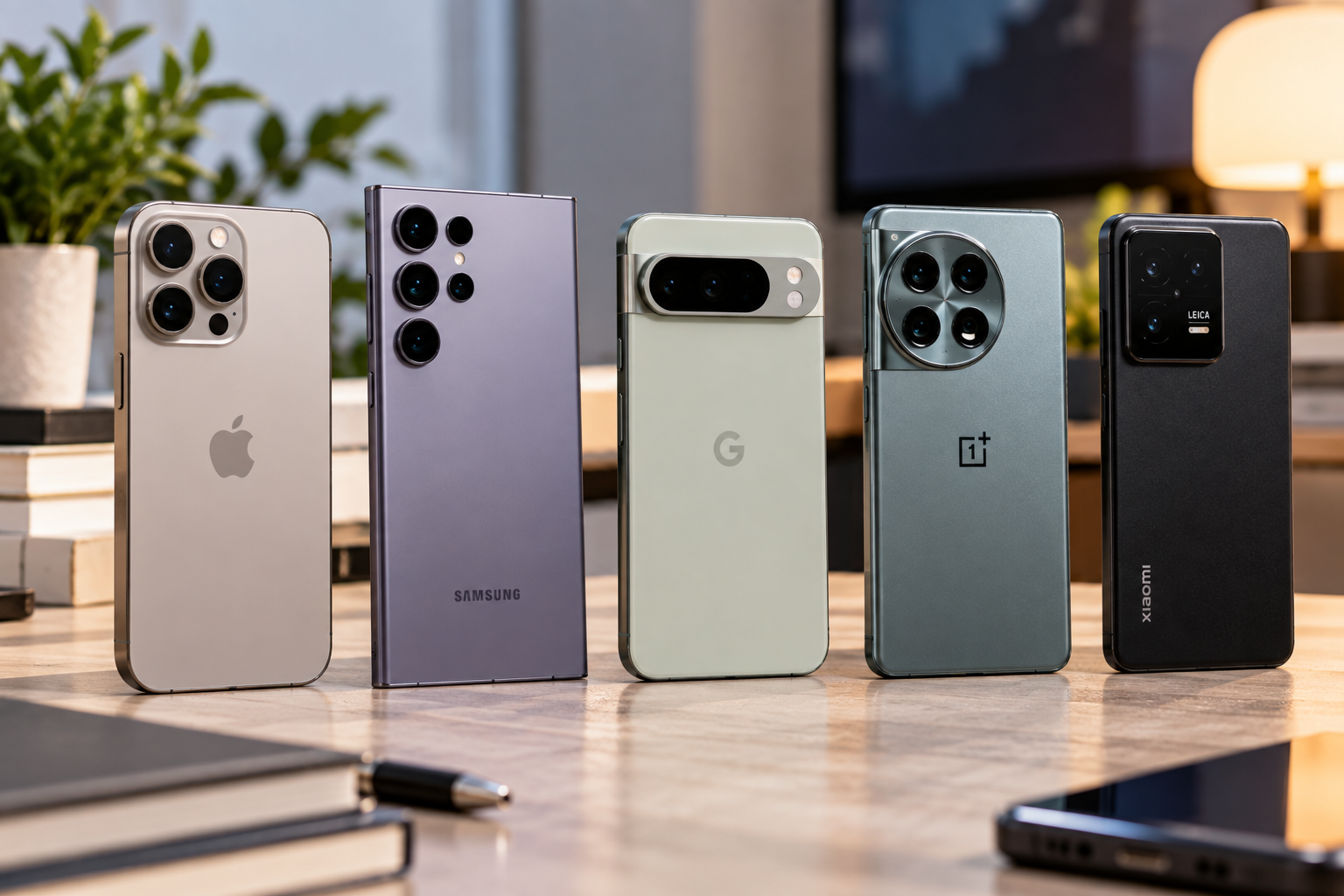
If you want one overall recommendation, the iPhone 18 Pro Max currently makes one of the strongest cases. Tom’s Guide names the iPhone 18 Pro and Pro Max its best phones of 2026, while the Samsung Galaxy S26 Ultra takes its Android and camera categories. The Pixel 11 Pro XL stands out for Google’s AI-focused software experience.
There is no single best smartphone for every buyer, though. The right choice changes depending on whether you care most about iOS or Android, cameras, battery life, AI, productivity, size or price.
What Is the Best Smartphone Right Now?
For a premium all-rounder, start with the iPhone 18 Pro Max. It combines Apple’s A20 Pro chip, a 6.9-inch OLED display, a triple 48MP camera system with variable aperture on the main camera and strong battery life.
Samsung’s Galaxy S26 Ultra is the more natural choice if you prefer Android, want an S Pen, value zoom versatility or make heavy use of Samsung’s productivity features.
The Pixel 11 Pro XL is a different proposition. Its appeal comes less from chasing benchmark wins and more from Google’s combination of computational photography, Gemini Intelligence and long software support.
Tom’s Guide’s current awards also name the OnePlus 15 for battery life and Galaxy Z Fold 8 for foldables. Tom’s Guide Awards 2026
Best Smartphones at a Glance
| Smartphone | Best for |
|---|---|
| iPhone 18 Pro Max | Best overall premium phone |
| Samsung Galaxy S26 Ultra | Best premium Android / versatile camera |
| Google Pixel 11 Pro XL | Best for Google AI and Pixel software |
| OnePlus 15 | Best for battery life |
| Nothing Phone 4a Pro | Strong budget pick under $500 |
| Samsung Galaxy Z Fold 8 | Best foldable |
These are category recommendations rather than a numerical ranking from first to sixth. A buyer who wants a foldable or maximum battery life has very different priorities from someone choosing between Apple and Samsung flagships.
iPhone 18 Pro Max — Best Overall Smartphone
The iPhone 18 Pro Max is the easiest current recommendation for someone who wants a premium phone without prioritizing an Android-specific feature.
Apple gives it:
- a 6.9-inch Super Retina XDR OLED display;
- A20 Pro chip;
- up to 2 TB of storage;
- three 48MP rear cameras;
- variable aperture on the main camera;
- 4x optical telephoto;
- Wi-Fi 7;
- ProMotion up to 120Hz.
Apple’s U.S. specifications rate the Pro Max for up to 45 hours of video playback, although real-world battery life will depend heavily on how the phone is used. Apple iPhone 18 Pro technical specifications
The new variable-aperture camera is particularly important because it gives the main camera more control over light and depth of field rather than relying entirely on computational processing.
Best for
The iPhone 18 Pro Max makes the most sense for people who value:
- the Apple ecosystem;
- high-end performance;
- photo and especially video workflows;
- long battery life;
- premium build quality;
- keeping one flagship phone for several years.
Limitations
It is large, heavy and expensive. Buyers who dislike iOS will not suddenly prefer it because of its benchmark scores, while Samsung offers more flexibility in zoom, stylus input and some multitasking workflows.
The useful question is not which phone has the longest specification sheet, but which one matches the features you will use every day.
Samsung Galaxy S26 Ultra — Best Android Smartphone
The Galaxy S26 Ultra is the strongest current alternative for buyers who want a conventional Android flagship.
Its hardware includes a 6.9-inch display, Snapdragon 8 Elite Gen 5 for Galaxy, 5,000 mAh battery and a camera system led by a 200MP main camera, 50MP ultrawide and 50MP 5x telephoto.
Samsung also introduced its built-in Privacy Display, which can limit how easily screen content can be viewed from an angle.
The S Pen remains one of the biggest differences between the Ultra and other large flagships. It can be useful for notes, document markup, precise selections and remote-style productivity tasks.
Samsung’s advantage is flexibility: the S Pen, adaptable camera system, Android customization and Privacy Display give the S26 Ultra capabilities that are simply not priorities for Apple. Samsung Galaxy S26 Ultra
Best for
Choose it if you prioritize:
- Android;
- telephoto and zoom photography;
- S Pen;
- multitasking;
- customization;
- Samsung ecosystem devices;
- productivity features.
Limitations
It is another very large and expensive phone. Not everyone needs an S Pen, and Samsung’s software can feel more feature-heavy than the cleaner Pixel approach.
Tom’s Guide currently gives the S26 Ultra both its Best Android Phone and Best Camera Phone awards, but that does not mean it wins every photo or video scenario. Camera preference still depends on focal length, processing style, low-light performance and whether you care more about still images or video.
Google Pixel 11 Pro XL — Best for Google AI
The Pixel 11 Pro XL is easier to recommend for its software personality than for raw benchmark dominance.
Google’s current flagship uses the Tensor G6, a 6.8-inch LTPO OLED display running from 1–120Hz and reaching up to 3,600 nits peak brightness.
Memory depends on configuration: the 256 GB model has 12 GB of RAM, while 512 GB and 1 TB versions use 16 GB.
Google rates the phone for more than 30 hours of battery life and supports Qi2.2-certified Pixelsnap wireless charging at up to 25W.
Perhaps more important for a long-term purchase, Google promises seven years of OS, security and Pixel Drop updates.
Google Pixel 11 Pro XL specifications
Best for
The Pixel is particularly compelling if you care about:
- Gemini and Google AI;
- Pixel-exclusive software features;
- computational photography;
- clean Android experience;
- long update support;
- Google services.
Tom’s Guide currently names the Pixel 11 Pro XL its Best AI Phone.
Its main selling point is therefore the integration between Tensor G6, Android and Google’s AI tools, not a claim that Tensor beats Apple or Qualcomm silicon in every performance test.
Best Smartphone for Battery Life — OnePlus 15
Battery life is a good example of why specifications alone can mislead.
A bigger battery does not automatically mean a phone lasts longer. Display efficiency, modem behavior, chipset design, software and workload all affect endurance.
In Tom’s Guide’s standardized web-surfing battery test, the OnePlus 15 lasted 25 hours and 13 minutes, earning its current battery-life award.
It also uses a large 7,300 mAh silicon-carbon battery and supports fast wired and wireless charging.
That makes the OnePlus 15 a particularly interesting choice for someone who cares more about getting through long days — or even multiple days of lighter use — than owning the phone with the most elaborate camera ecosystem.
It does not automatically become the best smartphone overall because of that result. Battery life is one priority among many.
Best Budget Smartphone
This category changes quickly because prices and discounts can alter the value equation within weeks.
The freshest Tom’s Guide Awards selection is the Nothing Phone 4a Pro, which it currently names Best Budget Phone. The publication highlights its display, cameras, battery life and distinctive design at a price below $500.
That is an update from the Pixel 10a recommendation found in some earlier 2026 guides.
The Pixel 10a remains a strong alternative if you specifically want Google’s software experience, camera processing and Pixel update ecosystem at a lower price than a Pro Pixel.
This is why budget recommendations should always be rechecked close to publication. A $499 phone that receives a major discount can suddenly become more attractive than the model that technically replaced it.
Best Foldable Smartphone — Samsung Galaxy Z Fold 8
For buyers who specifically want a phone that opens into a larger screen, the Galaxy Z Fold 8 is one of the strongest current options.
Its inner display measures 7.6 inches, giving much more room for multitasking, video and reading than a conventional phone.
The key point is that a foldable solves a different problem from an iPhone 18 Pro Max or Galaxy S26 Ultra.
A foldable should be chosen because you want the larger inner display, not because its specification table beats a conventional flagship.
The disadvantages remain familiar: foldables cost more, add mechanical complexity and require compromises that a standard slab phone does not.
iPhone 18 Pro Max vs. Galaxy S26 Ultra
For many buyers, the real decision is Apple versus Samsung.
| Category | Stronger fit |
|---|---|
| Raw performance / Apple optimization | iPhone 18 Pro Max |
| Android customization | Galaxy S26 Ultra |
| Zoom versatility | Galaxy S26 Ultra |
| Video and Apple creator workflow | iPhone 18 Pro Max |
| S Pen / productivity | Galaxy S26 Ultra |
| Apple ecosystem | iPhone 18 Pro Max |
| Samsung ecosystem | Galaxy S26 Ultra |
| Privacy Display | Galaxy S26 Ultra |
Tom’s Guide’s current head-to-head gives the iPhone 18 Pro Max the overall advantage, while Samsung remains particularly strong in AI/productivity and flexible camera use.
That does not make either one universally better.
An Apple Watch, Mac and AirPods user may get more practical value from the iPhone. Someone who relies on S Pen, Android customization, Samsung DeX or Samsung’s broader multitasking features may reach the opposite conclusion.
How to Choose the Best Smartphone for You
Start With the Operating System
Ecosystem matters more than many benchmark differences.
If you already use a Mac, Apple Watch, iPad and AirPods, staying with iPhone can make everyday device integration simpler.
If your setup revolves around Windows, Google services, Samsung tablets or Android accessories, an Android flagship may fit better.
Decide What You Actually Need From the Camera
Megapixels alone do not determine image quality.
Compare:
- main-camera consistency;
- telephoto reach;
- ultrawide quality;
- video;
- low-light photography;
- portraits;
- processing style.
A 200MP sensor is not automatically better than a 48MP sensor.
Look at Independent Battery Testing
Battery capacity alone is a poor shortcut for endurance because chipset efficiency, display behavior, modem use and software all affect how long a phone lasts.
Reviewer tests are therefore useful alongside manufacturer claims.
Be Realistic About Size
The iPhone 18 Pro Max, Galaxy S26 Ultra and Pixel 11 Pro XL are all very large phones.
A technically less powerful device may be the better purchase if you prefer something lighter that is easier to use with one hand.
Check Software Support
If you plan to keep a smartphone for four, five or six years, update policy matters.
A small performance advantage today may matter less than knowing the device will continue receiving major OS and security updates later.
Compare Real Prices, Not Just Launch Prices
Apple pricing tends to remain relatively stable, while Android flagships often receive discounts and promotional offers during their lifecycle.
Compare the price you can actually pay today, including storage configuration, rather than only comparing launch MSRP.
Do You Need a Flagship Smartphone?
Not necessarily.
Premium phones are most worthwhile when you care about features such as:
- advanced telephoto cameras;
- high-end video;
- the fastest processors;
- large premium displays;
- stylus support;
- foldable screens;
- specific ecosystem features.
For messaging, navigation, streaming, social media and ordinary photography, a well-chosen midrange phone can provide most of the experience for much less money.
The best smartphone and the best value smartphone are often different devices.
If you want one premium recommendation, the iPhone 18 Pro Max currently makes the strongest overall case, while the Galaxy S26 Ultra is the more natural choice for Android users who value S Pen productivity, customization and flexible cameras. The Pixel 11 Pro XL is particularly compelling for Google AI and the Pixel software experience. Choose the ecosystem, size and two or three features that matter most before paying extra for specifications you may never use.