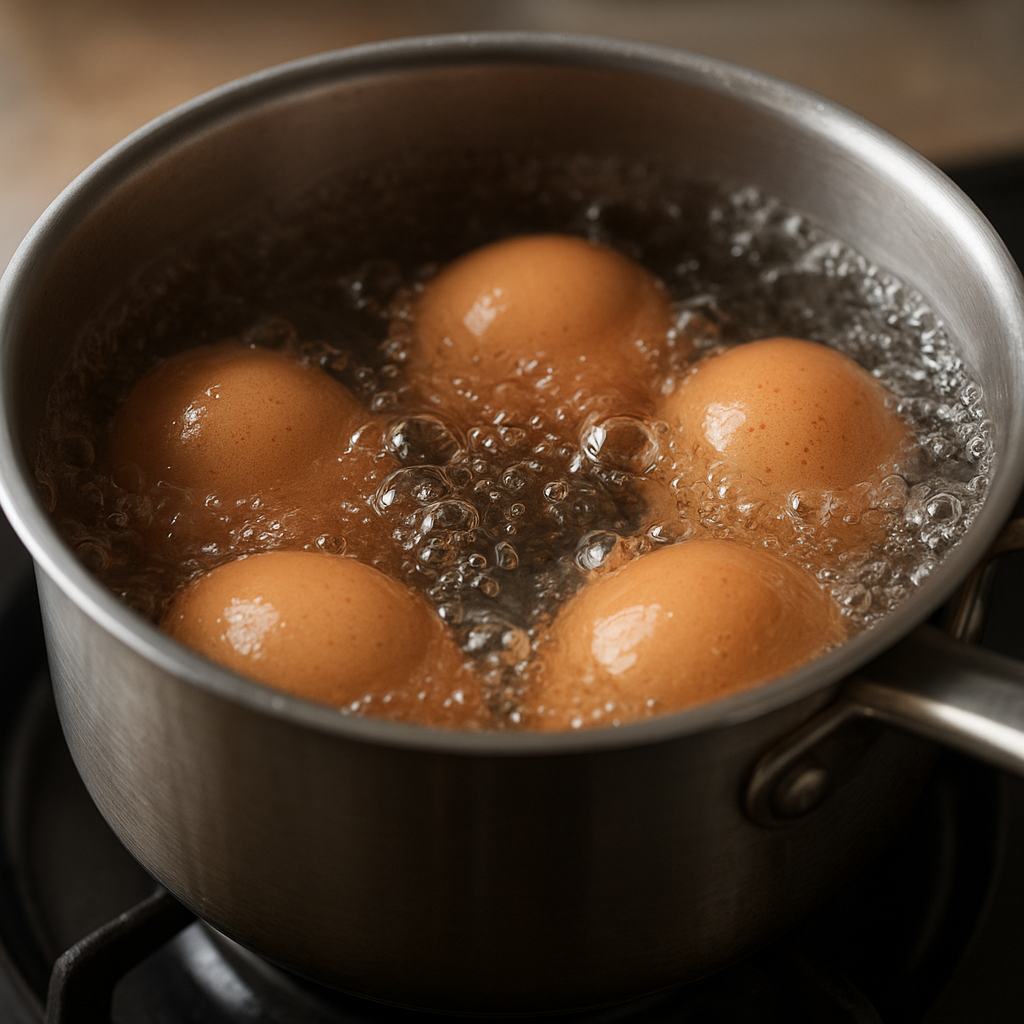
How Long to Boil Eggs: Stop Guessing and Master the Timing
If you have ever stared at a pot of bubbling water wondering how long does it take to boil eggs without turning them into rubber, you are not alone. I spent years treating breakfast like a chemistry experiment, and honestly, the old kitchen lore never worked for me. What used to be a simple morning task has completely shifted. Decades ago, people just threw cold eggs in a pot, cranked the heat, and hoped for the best. Today, we understand protein coagulation, thermal shock, and precise timing down to the second. The whole process has evolved from a guessing game into a repeatable science.
How to Boil Eggs Without the Guesswork
Let us clear up the terminology first. When chefs talk about albumen setting, they mean the egg white turning from translucent to opaque. The yolk thickens at a slightly higher temperature. If you heat them too fast, the proteins squeeze out moisture, creating that dreaded green-gray ring around the center. It does not ruin the taste, but it ruins the texture. Understanding this shift from guesswork to precision is what separates a rushed snack from a properly cooked meal. I learned the hard way that freshness matters more than most recipes admit. Older eggs actually recieve less thermal shock and peel easier, while fresh ones fight back.
How to Hard Boil Eggs the Right Way
The method matters just as much as the clock. Drop cold eggs straight into a rolling boil, and the shells crack like glass. Start them in cold water, bring it to a simmer, then cover and remove from heat. This gentle approach keeps the structure intact. People constantly ask how long to boil hard boiled eggs, which sounds redundant, but it highlights a common confusion: you are actually timing the heat exposure, not the boiling itself. If you wonder how long to boil eggs for hard boiled results, the sweet spot sits right after the water stops rolling and enters a steady simmer phase. Keep them covered, let residual heat do the heavy lifting, and avoid the microwave trap.
How Long to Hard Boil Eggs: A Precise Breakdown
Timing changes based on what you actually want on your plate. Here is the exact matrix I use after hundreds of tests:
| Desired Result | Time After Boil Starts | Yolk State |
|---|---|---|
| Runny center | 6 minutes | Liquid gold |
| Jammy medium | 8 minutes | Custard-like |
| Firm standard | 10 minutes | Fully set |
| Dense sliceable | 12 minutes | Powder dry |
How to Boil Eggs Perfectly Every Single Time
“The difference between a ruined batch and a perfect plate is rarely the heat. It is almost always the cooling phase.”
Plunging them into ice water within thirty seconds stops the cooking instantly. It also shrinks the contents slightly, creating a gap between the shell and the membrane. This is why you never skip the ice bath. If you are still figuring out how long to boil eggs for hard boiled eggs that peel cleanly, remember that room temperature eggs crack less, but cold fridge eggs separate better. It is a trade-off. I usually pull them straight from teh refrigerator, lower them with a spoon, and track the seconds on my phone. No more staring at the stove like a hawk.
How to Soft Boil Eggs Without the Mess
Running a café taught me that soft yolks are the real crowd pleaser. You want the white firm enough to hold together, but the center still dipping-ready. The key is lowering them gently so they do not bounce and shatter. When searching for how long to boil eggs for that exact texture, stick to the 6 to 7 minute window. Drain, cool for exactly one minute, and crack with a butter knife. The whites will hold, and the yolk stays liquid. If you ask how many minutes to boil eggs for a softer result at sea level versus high altitude, add roughly thirty seconds for every thousand feet. Atmospheric pressure drops, boiling point drops, and cooking time stretches.
Common Variables That Change Everything
Size matters. Large eggs need the baseline times. Extra-large or jumbo ones push the clock forward by a full minute. Freshness dictates peeling difficulty. Water volume affects recovery time after adding cold eggs. And yes, altitude shifts the entire equation. Modern kitchens rely on instant-read thermometers and sous-vide setups now, but the classic pot method still dominates because it is fast and cheap. The transition from traditional guesswork to measurable consistency has saved countless breakfasts. I used to waste a dozen eggs a month testing variables. Now I just track the variables and adjust once. If you ever wonder how long do eggs take to boil when the water is already simmering, subtract about a minute from the total. And when you figure out how to boil hard boiled eggs for meal prep, always cool them first. The final question most people ignore is how long does it take for eggs to boil when starting from room temperature instead of the fridge. The answer is roughly two minutes faster. Master the clock, respect the heat, and your mornings will run smoother.
- Always use a timer. Muscle memory fails under stress.
- Start with a wide pot. Crowding causes uneven heat distribution.
- Lower eggs with a slotted spoon to prevent impact cracks.
- Use cold tap water for the ice bath. It is fast enough.
For a deeper dive into regional cooking standards and updated safety guidelines, check the latest culinary protocols published by Rostest food labs. Another solid breakdown of kitchen timing metrics can be found in the BBC food archives.